



Power Tool Battery Care
Power Tool Battery Care: The Complete Australian Guide
Power tool battery care is the most overlooked factor in jobsite efficiency. Whether you are running Makita XGT, DeWalt XR, HiKOKI Multi-Volt, or industrial Metabo platforms, your batteries are the heartbeat of your business. As a nationwide supplier based in Western Australia, Alltools WA sees firsthand how the Australian climate, from the humid north to the frosty south, can destroy expensive gear if not managed correctly.
Why Power Tool Battery Care Matters in Australia
Australia’s diverse environment presents unique challenges for Lithium-Ion (Li-ion) chemistry. Proper power tool battery care isn’t just about making them last through the day; it’s about protecting a multi-thousand-dollar investment over several years.
1. Temperature Management and Battery Health
The internal chemistry of a battery is a delicate balance.
-
Heat Exposure: In Western Australia and the Northern Territory, ute temperatures can easily exceed 60°C. This cooks the internal cells, leading to permanent capacity loss. Always store your kit in a shaded, ventilated area.
-
Cold Climate Performance: For those in Tasmania or the Victorian Highlands, cold temperatures increase internal resistance. If your DeWalt or HiKOKI battery feels sluggish on a frost-covered site, bring it to room temperature before use.
-
The Cooling Phase: Never jump-start a hot battery on a fast charger. Give it 15 minutes to stabilize to prevent thermal stress.
2. Charging Strategies for Power Tool Battery Care
To maximize cycles, you need to understand how Li-ion behaves. Unlike old nickel-cadmium batteries, modern packs don’t need to be “cycled” to zero.
-
Avoid Deep Discharge: Stop using the tool as soon as you feel a power drop. Forcing a Makita or Metabo battery to work when it’s nearly empty can drop the voltage below the “recovery point,” making it unrecognizable to the charger.
-
The Storage Sweet Spot: If you are “parking” a tool for more than a month, store the battery at roughly 50% charge. Storing a battery at 100% in high heat is just as damaging as storing it at 0%.
3. Brand-Specific Innovation: Metabo, HiKOKI, and Others
While we carry all the major players, different brands offer unique tech for power tool battery care:
-
Metabo Ultra-M Technology: Metabo’s system is famous for its communication between the machine, battery, and charger. Their Air-Cooled charging technology ensures the pack stays at the optimum temperature while docked.
-
HiKOKI Multi-Volt: These batteries are engineered to handle high-demand 36V tasks with less heat buildup than traditional 18V systems.
-
The “Others” and Specialty Platforms: From specialized fabrication tools to standard kits, the same rules apply: keep the rails clean of metal shavings and dust to prevent parasitic draw.
4. Maintenance for Nationwide Longevity
Maintaining your gear is simple but essential.
-
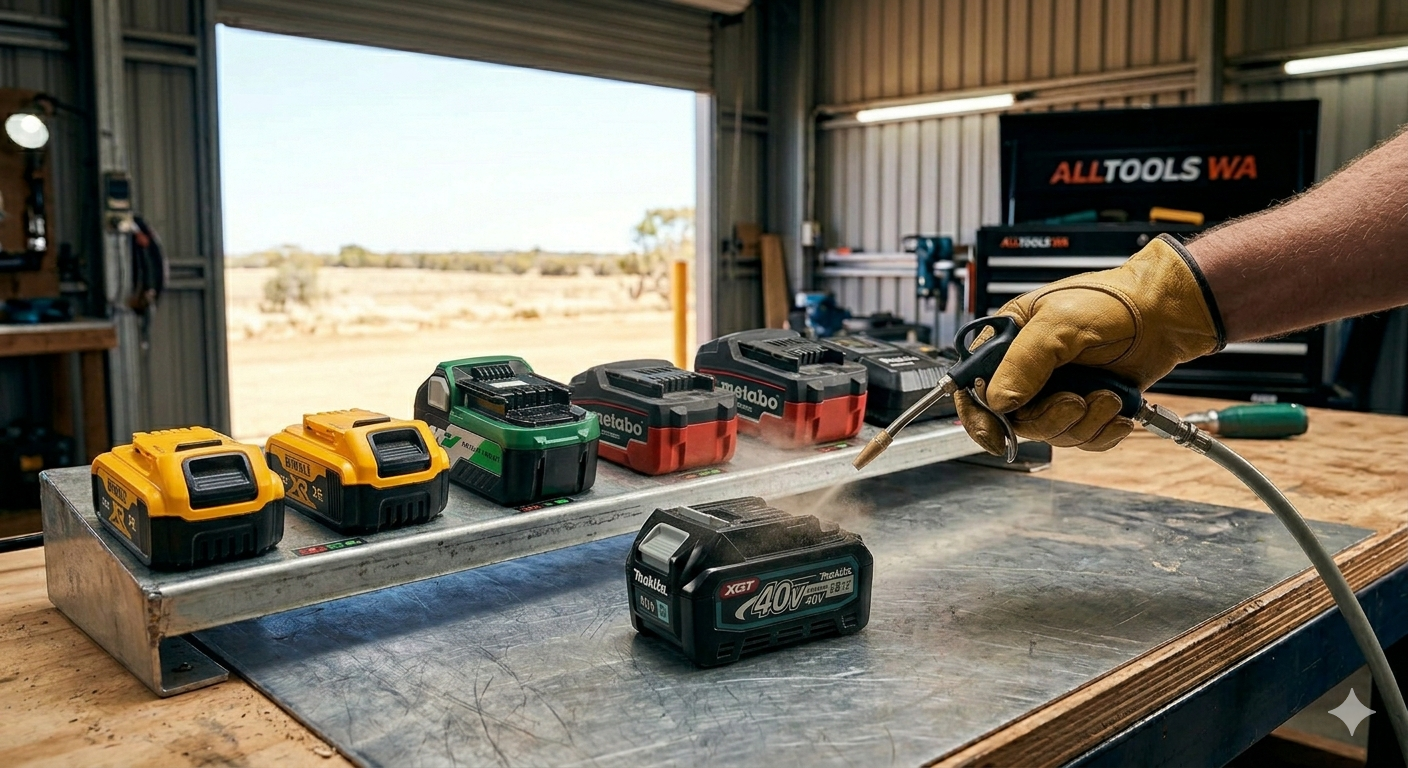
Blow out the terminals: Use compressed air to clear the contact points.
-
Inspect the Casing: A cracked housing is a gateway for moisture and salt air, leading to internal PCB corrosion.
-
Secure your Load: Ensure batteries aren’t rattling loosely in the back of a van.
For more professional advice or to upgrade your current kit, browse our full range of batteries and chargers here.
What you can read next